Gatwick Forest City as Cliff Pictures It
Forest City, Gatwick, England.
I followed up an article in the Telegraph because it sounded fabulous. A new city designed from first principles, with no historic entanglements, no personal cars, no petrol or diesel, and no filling stations.
Please note, this view is based on what Cliff has read, on brief conversations with the lead actors in Forest City 1, Cambridge, and on his own investigations into future facilities and technologies.
We are all aware that nothing of what follows can happen without the goodwill of all the people who currently live here, so to achieve this we can only pledge to do whatever is in our power to keep that goodwill. We can confidently say that every facility and service will be available to the whole community.
I am borrowing all the work creating the Forest City 1 Project near Cambridge. I, however, use a different forecast for people movement.
We are proposing to build for the future, where the work is office-style rather than factory-based, so minimising the physical movement of both men and materials.
Our new world is built around brainpower, concentrated into a “hive”; the more concentrated the better, supported by the best, whether electrical, digital, social, materials, culture or health.
Five key elements have come together:
- Community Land Trust, thus making land affordable.
- Demise of personally-owned cars, thus freeing up land.
- The transformational growth in the speed of creating and disseminating new information.
- The power of integration, exemplified by the Crick Institute.
- The advent of new construction materials, new designs and new methods.
The Unique Selling Proposition to every person:
“A short walk to work,
A short walk to the shops,
A short walk to your favourite sport,
Or a short walk to the best culture, music and drama.
And have a three-hour break every day to help bring up a family, or whatever you want to do.”
In previous generations, people like the Cadburys, Pilkingtons and Rowntrees built new villages and towns because they wanted a good workforce and wanted to give them a good lifestyle.
Now we are in the twenty-first century, and this time we need to do better than they could.
Size
50,000 acres, of which 15,000 is forest, 1,500 is a lake, and 1,280 acres is for the city itself, with the rest mixed farming and leisure. This would be suitable for one million people to live, work and enjoy their leisure — a place to bring up a family.
The first stage is to attract businesses and then to attract the people. To attract young people it needs to be exciting and it needs to be affordable.
Location
ESE of Gatwick Airport. It is 3–5 miles from Gatwick railway station and airport. Express buses will run to Crawley town, Sussex University, the West End and Brighton as needed.
The airport enables easy access for owners and top executives to fly almost directly to their offices. Private and open helipads are also available.
Index
- The City Layout
We can easily see a giant Antonov landing and then disgorging a huge earth-moving grader, ready to start gouging out the two tunnels that will run underneath the city. - The Culture and Society for the Forest City
Next after the tunnels, it’s time to create the open amphitheatre to welcome the thousands of cheering fans. - The Homes and Offices
There will eventually be a dozen or so towers ranging in height from thirty floors to seventy floors. - The Forest City Schools and Education
The best schools and education are being set up ready for the two hundred thousand students, from nursery through to university. - The Manufacturing Dimension
The primary manufacturing will be involved in high-quality materials and technology. - The Medical and Health Strategy
Health is an inherent element in our society, as it is part of being the best. - The Energy Equation
We are very fortunate to be creating a new city just when the old technologies based around fossil fuels and carbon-based fuels are finished. We have a 1.2 MW wind farm proposed locally offshore. - The Defence, Security and Policing
In the middle of the triangle of Ukraine, the United States of America and Iran, we have developed our own defence structure. - The Forest
The forest lays the ground rules for our sustainable society. The nurturing of all the forest dwellers sets the base of our culture and indeed the direct interplay with our lives. - The Water Services
This is working to help nature and thus to help our society. - The Entertainment and Leisure Activities
With probably over half a million of the best people around, we are confident our people will create and enjoy the very best entertainment and sports. - The City’s Reputation
We wait to see what develops over the next five hundred years.
Our Forest City
Our Forest City is a quiet, calm, peaceful-looking city, with parks and squares, bushes and trees. A green haven of parks and squares, and of ducks, geese, deer and roebuck.
Even the traffic is quiet. All the vehicles are electric, from the heavy trucks, buses, cars, scooters and delivery bots, to goods chariots and pack-usage pens.
All deliveries arrive through the three-lane tunnel highways.
The left-hand lane is used as the bus lane and also for delivery trucks to pull off the road onto the office and hotel driveways, so that the delivery bots can unload themselves and make their way to the lifts, corridors and concourses to get to their precise destinations.
Each element is carefully choreographed, from the delivery trucks designed so that everything unloads itself. This includes buggies, cages and hoppers, all designed to be able to use lifts, ramps and corridors safely.
Bicycles have their own network of paths and byways, as they are not allowed on the highways or pedestrian paths. The ubiquitous scooters can go anywhere other than the highway, up to the speed limit of five mph.
The latest buses have no fixed seats on the lower deck; all fixed seating is on the upper level. This means double-deckers, which means higher roof levels for the tunnels.
Each bus can carry 167 people and, using new software, can be brought together to form a coach-train of, say, twelve buses, carrying 2,000 people. Buses run with a frequency of twelve minutes, with extra buses immediately available, arriving after ten minutes.
These coach-trains can be instantly reverted to individual buses for absolute maximum flexibility, eliminating any benefit from tracked trains.
The main footpaths are wide enough to carry a bus for emergencies, though the buses normally run in two closed loops in the correct direction on both dual carriageways connecting to Gatwick City Airport, the hospital and Gatwick railway station. In the tunnels, passengers will alight onto raised pavements with direct access to all nearby buildings.
With respect to trucks and lorries, these can use the same structure as single-decker buses and are converted so that cages, hoppers etc. can roll up the ramps.
Personal and taxi helicopters hover and drop onto private or open helipads built as a part of every block and tower.
1. The City Layout
This piece of the city is a rectangle 2,640 ft long and 1,320 ft wide along the northern edge, an area totalling 80 acres. This is just a small part of the 1,280 acres, the two square miles allowed for the city.
This northern strip has two facing triangles, providing a 440-yard block to all north winds. With two north/south blocks, one on the left edge and one on the right, this will create a sheltered area for walking, cafes and window shopping.
Beneath this plaza are four decks of luxury apartments with wide concourses and plenty of light and space. The area supports 48,000 people.
The full area is 2,640 ft long, so there will be moving pavements on each side, both at Floor 1 level and Floor 4, linking all the homes to all the shops, factories and offices. All the factories are expected to be low-volume, high-quality, operating in a clean and quiet environment.
Further to the south, there are horseshoe-shaped buildings so as to create further sheltered areas. Each consists of three blocks, two running east/west and one north/south, to shelter from the bitter east wind.
The height of all these buildings is between 30 and 70 floors.
Some will be homes and shops, some offices, together with schools, universities and medical facilities. Corner shops, as well as supermarkets and cafes, will abound.
The whole of the land is covered with grass, bushes and trees.
2. The City Culture and Society
The slogan is “We do best”, not just better, “We do best”.
This means that we need the best concert hall in England. Good enough to persuade Sir Simon Rattle back to England.
Get him, and we have a centre of excellence for music, dance, ballet and opera, plus the recording studios and superstar performers.
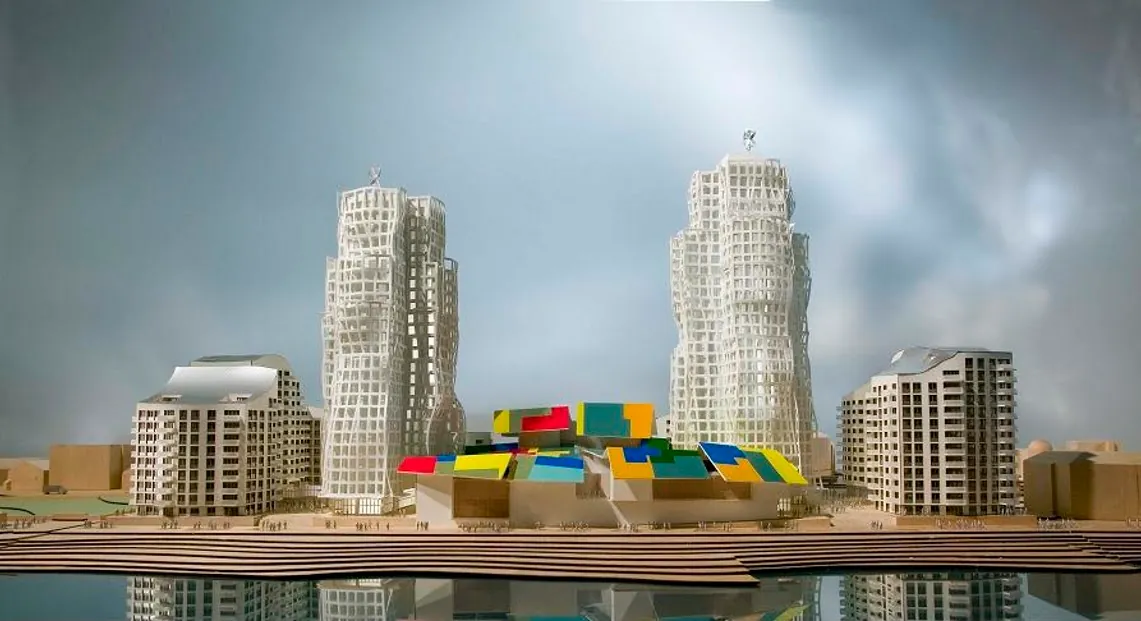
Then we have the Frank Gehry leisure centre — just outrageous design and tremendous facilities.
The list of sports provided in a “city of a million” is almost endless, for example orienteering, skateboarding, dry-ski slopes and skeleton courses, sailing, both racing dinghies and foiling racing yachts, swimming, diving, running, both park runs and marathons, plus cycling competitions of all sorts.
Which means:
- Best health facilities.
- Best opportunities for grandchildren.
- Best society.
- Best sports.
- “Blue Zone”.
- Best value for you.
- Better public transport.
- Back-up electricity from our own power station.
- New airport.
- Still as green as now.
People are setting up members’ clubs, bringing together everyone with the same enthusiasms:
- Art Club.
- Choirs.
- Civil Defence Club.
- Cycling Club.
- English Club.
- Entrepreneurs and Enterprises Club.
- Fishing Club.
- Good Better Best Club.
- IT Support Club.
- Mandarin Club.
- Orchestra.
- Seniors Club.
- Volunteers Club.
- Wild Flower Club.
- Yacht Club.
Maybe each block will be named by science or knowledge group, e.g. Biology, and each street or green after a Nobel Prize winner.
3. The Schools and Education
Everything is about choice and competition — “We do best” — so both private and state schools exist. At secondary level these are represented by Bohunt, state, and King Edward’s School, private.
Universities from the UK and the rest of the world will be encouraged to open new colleges and new branches.
We can probably grow the city fourfold, so there is plenty of space for everyone.
4. The Homes
There are 200, 400, 800, 1,200 and 1,600 sq ft homes available. All have a ceiling height of 8 ft.
Five sizes are available:
- 200 sq ft: a shared bedsit with a shared kitchen lounge, plus individual bedroom, with wash-basin, shower and toilet. £60,000.
- 400 sq ft: a two-bedroom home with lounge, bathroom and shower room. Cost target: £120,000.
- 800 sq ft apartment: a three-bedroom home with bathroom and separate toilet, for 4 or 5 people. Cost: £240,000.
- 1,200 sq ft: a four-bedroom home with two bathrooms and a separate toilet in each apartment, for 4 or 5 people. Cost: £360,000.
- 1,600 sq ft luxury apartment: with, for example, three bath and shower rooms. £480,000.
All homes have viewing panels for a natural view of the surrounding land, or the forest, lake, or as a standard TV for broadcasts or favourite DVDs.
The corridors and concourses are decorated with TV screens displaying pictures from the national collection used by MPs and civil servants.
The ceilings of these areas will be enlivened with huge “Sky Panels”, say 40 ft by 10 ft, showing the actual live sky, or a preferred sky, Hawaii, if it is raining.
There is space for about 50,000 on the four decks under the plaza, plus 100,000 in the northern block across the 1,320 ft width. See working notes attached.
Then there is the space in the remaining towers.
The Community Land Trust provides the land at no cost so that owners can get a home at a price they can afford while they get established. They are expected to take the opportunity to build sufficient funds so as to buy on the open market. The contract period is for ninety-nine years.
When the owner dies, the trust will buy back the apartment at the full current price, or review the options with the bereaved family. Prices increase annually by the change in RPI, the Retail Prices Index.
If the owner defaults and the apartment has to be repossessed, then the trust will pay the lender the debt outstanding and take back the property, and will then discuss the difficulty with the occupier.
Each owner is expected to repaint the outside once every three years and inside once every five years, and to keep the property as originally received continuously.
When vacating the apartment, the owner receives the full current price less up to 20% for depredations.
Every owner needs to budget for Council Tax at 1.2% p.a.
For those people who want to start a business “in their own garage”, five 800 sq ft spaces are available at a peppercorn rent each year for a maximum period of five years, when a full commercial rent will start.
5. The Manufacturing Dimension
All the buildings will be designed to be used as homes or offices, shops or factories, or schools, medical facilities or whatever.
We envisage a city and its members all using the latest technologies and linked with data hubs across England and Europe. The imports will be largely food and the exports largely IPRs, patents and extremely high-quality short-run manufacturing, medical and robotics.
The target companies we have in mind are developing new products and new services, and using new methods and materials through innovation and invention, or by revisiting existing methods and systems, or by writing new software.
Then there are the creators of new knowledge, the research scientists working on new materials, genes and the brain.
Not forgetting the “imaginators”, to see how something might be done; the “who, what, why, when, where and how” people.
We shall be the focus for the Information and Intelligence Revolution, as Birmingham was for the Industrial Revolution.
6. The Medical and Health Strategy
We are starting with a younger age group, we assume primarily twenty to fifty-year-olds. Our objective is to become a “Blue Zone”, where we have a high rate of centenarians and a low rate of chronic diseases.
To this end there are multitudinous sports available, our own fish farms, a close relationship with our farming community and with our food shops and restaurants. However, we recognise we can only “nudge” rather than control.
This approach needs to fit with private healthcare and the services provided by the NHS, with the co-operation of all our employers and the ethos and spirit of everyone living here. Together, we need to create our own ethos.
7. The Energy Equation
No one has the right solution, so we have chosen a mix of tactics.
In the first instance, all homes, shops and offices will have battery storage so that we only use power when no one else needs it.
We have lots of solar power, with a gas-fired power station as a back-up.
We will have the first Small Nuclear Reactors for when the sun doesn’t shine.
There will be district hot water systems using excess heat from the super-computers and also some of our greenhouses.
Our buildings are all energy efficient.
The south-facing walls of all buildings will be covered in solar panels.
8. The Defence, Security and Policing
Everything and every person we have here is extremely valuable, and there are many countries, companies and people who will be extremely jealous of who we are, what we have achieved, and what we can achieve.
With the help of all the relevant bodies, we have developed a detailed security strategy. From border controls to intellectual property rights, we have our own teams to keep you and yours safe.
9. The Forest
We have 12,000 acres of woodland at present, and these woodlands are being extended and linked together, around existing buildings and roads, so as to make one contiguous whole. This means that all wildlife will be able to move safely everywhere in the forest.
Naturally, the forest will also be used for recreation: orienteering, wild flower protection, cycle tracks, cross-country running and country walks.
And then we will need to consider forest management and the wild animals, including hunting or culling the deer.
10. The Water Services
Our water service technologists have designed us a system that uses only 35% of normal household usage by collecting and treating grey water. This means that, with our new reservoir, the same size as Graffham Water, we will be self-sustaining.
We envisage fish farming of rainbow trout.
So let’s go sailing and fishing.
11. The Entertainment and Leisure Activities
Obviously, our prime thrust will be music, though we are expecting Specsavers, Boots, John Lewis, IKEA, Foyle’s, Waterstones and Wetherspoons to join us.
Restaurants show their own flags and colour schemes: Italian, Bangladeshi, Chinese, Turkish, Greek, Spanish — the only places to hear those languages.
Running and cycling races, all finishing in the Padron Plaza for everyone to cheer and congratulate the winners and all the participants.
Whole forests with bridle paths, cycle lanes etc.
Two football clubs and two stadiums eventually, though initially an open-air amphitheatre seating 50,000 will do the job.
And then there are all the parties and the traditional balls, and who knows how many universities we might end up with.
12. The City and Its Reputation
We can only do so much. We can have lots of slogans and do lots of work, but actually our reputation is not in our hands but in yours. It depends on your ideas, your systems, your teamwork, your insights, your work regimen, your social discipline and your standards.
All we can really do is to help you when necessary.
Thank you.
Cliff Jenkins
Working Papers
For the plaza area
2,640 ft long allows 44 rows, or streets.
40 ft, 30 ft concourse, 40 ft, plus 10 ft safety corridor = 120 ft.
1,320 ft wide allows 66 units, each 20 ft wide.
44 x 66 = 2,900 units for 4 people to live there = 12,000 people.
12,000 per deck = 48,000 for 4 decks.
For the northern wall
1,320 ft long allows 66 units per row, with 20 ft wide units.
40 ft, 30 ft concourse, 40 ft, plus 10 ft safety corridor = 120 ft.
So 4 double rows = 480 ft wide block.
66 rows x 4 people = 264 x 8 rows x 50 floors = 105,600 people.
So total people = 150,000.
This leaves all the remaining towers.
Each tower: 420 x 210 = 88,200 sq ft per floor.
88,200 x an average of 50 floors = 4,100,000 sq ft.
Working space per person: 120 sq ft x 1.5 for common space = 180 sq ft.
Divided by 180 sq ft per person = space for, say, 22,800 people.
This means using 7 towers.
For the remaining 8 towers, at 88,000 sq ft, each person needs, say, 290 sq ft for working and 125 sq ft for living = say 400 sq ft in total.
This gives 220 people per floor x 50 floors = 11,000.
So for 8 more towers = say 90,000 people.
Please note, I have not allowed for the two moving pavements, each 30 ft wide, running north/south.
Using a new schematic
Let’s assume the whole of G1, the ground floor, is for shops, supermarkets, clubs, bars, chemists, hairdressers and other retail. Then the floor area would be:
- North Wall: 1,320 x 480 = 633,600 sq ft.
- Tower block each side: 2 x 210 x 420 = 176,400 sq ft.
- Total = 810,000 sq ft.
Similarly, each floor would provide space for between 6,750 and 2,800 people, depending on the work environment, using 120–290 sq ft each.
And for 4 complete floors = 27,000–11,200 people.
Therefore, 10 floors = 67,000–28,000 people.
Then at Floor 12, a complete floor of retail shops, restaurants etc., with a central moving pavement.
Maybe the concourses need to be 20 ft wide to allow for an extra moving pavement.